 c25a2c5c3b
* [CardDB] Avoid copying printing maps and property strings

Reading a card's sets was a measured hotspot: `SetToPrintingsMap setMap =
card->getSets();` copies the whole QMap, and then iterating it with a
non-const iterator detaches and deep-copies every PrintingInfo, including
its property hash, on first use. A micro-benchmark of that exact pattern
(copy plus non-const iteration) came out about 19x slower than a const
reference over the same data.

The querier, the cache writer, the XML writer, the picture loader and the
printing/set selection widgets now take `getSets()` by const reference and
only use const iterators. The tests that iterate generated data are
covered by the existing card database and picture loader suites.

String accessors were also returning by value where the value lives in a
hash that has already been materialized:
- CardInfo::getProperty() and the legacy getCardType()/getColors()/
  getManaCost()/getCmc()/getPowTough()/getLoyalty() accessors,
- PrintingInfo::getProperty(), getUuid(), getFlavorName(), getArtist(),
  and getSet(),
- ExactCard::getPrinting() and getCardPtr(),
- CardSet::getShortName(), getLongName() and getSetType().

getPrinting() in particular copied a PrintingInfo on every call, and a
copy of an unmaterialized PrintingInfo has to take the properties mutex.
Callers that need an owned copy still get one; the rest just read.

Other allocation removals in the same path:
- LazyPropertiesHash::ensureMaterialized() checks an atomic flag before
  taking the mutex, so property reads after the first one do not lock.
  The flag is release-stored after materialization and acquire-loaded by
  readers/copies, preserving the existing locking for the first read.
- CardSet::getCorrectedShortName() no longer rebuilds its QSet of
  reserved Windows file names on every call.
- CardSet::getIsKnownIgnored() no longer formats the release date into a
  throwaway string just to check its length.
- The querier builds its card-type/format count caches without
  `cards.values()` or a properties key list, reserves its result lists,
  and picks a random card without materializing `cards.keys()`.
- The querier's pinned-printing path reuses the CardInfoPtr it already
  has instead of looking the card up again by name.
- CardDatabaseCache/XML serialization copy the alt-name QSet by
  reference.
- The picture loader compiles its !prop!/!set! regular expressions once
  instead of per URL template, and walks the transform map with an
  iterator instead of keys() plus operator[].

Full build and ctest (628 tests) pass.

* [CardDB] Address review comments

PrintingInfo is a value type: it is stored in QLists and returned by value
from the querier, so a const-ref getter can hand out a reference into a
temporary. Return the QStrings and the CardSetPtr by value again.

The constFind lookup stays, so a property read still never materializes the
lazy property hash - only the last shared-data refcount is paid.

* [CardDB] Undo the const-ref QString return changes

QString is implicitly shared, so returning by value costs only a refcount
and avoids handing out references into a lazily materialized hash. The
constFind lookups stay, so a property read still never materializes the
hash.

* [CardDB] Use QMap::asKeyValueRange() in transformUrl

The range is a view over the map's own iterators and yields references to
the stored key and value, so it keeps the no-allocation property of the
manual const iteration.

---------

Co-authored-by: Lukas Brübach <Bruebach.Lukas@bdosecurity.de>

Cockatrice | Download | Related | Community | Contribute | Build | Run
To get started with Cockatrice ⇢ view our webpage
To get support, or suggest changes to the app ⇢ file an issue (How?)

To learn about the app and its code ⇢ read our code documentation
To help with development ⇢ learn how to contribute
Cockatrice
Cockatrice is an open-source, multiplatform application for playing tabletop card games over a network. The program's server design prevents users from manipulating the game for unfair advantage. The client also provides a single-player mode, which allows users to brew while offline.
This project uses C++ and the Qt libraries.
Download 
Downloads are available for stable releases and the current beta version in development.
There is no strict release schedule for either of them.
Latest stable release:


Latest beta version:


While incorporating the latest fixes and features, beta builds may not be stable or contain new bugs! Please report any findings and open new issues when testing them!
Related Repositories
- Magic-Token: File with MtG token data for use in Cockatrice
- Magic-Spoiler: Code to generate MtG spoiler data from MTGJSON for use in Cockatrice
- cockatrice.github.io: Code of the official Cockatrice webpage
- io.github.Cockatrice.cockatrice: Configuration of our Linux
flatpakpackage hosted at Flathub - Webatrice: Web client for Cockatrice servers (TypeScript / React)
Community Resources 
Join our Discord community to connect with other project contributors (#dev channel) or fellow users of the app. Come here to talk about the application, features, or just to hang out.
Important
For support regarding specific servers, please contact that server's admin/mods and use their dedicated communication channels rather than contacting the team building the software.
Contribute
Code | Documentation | Translation
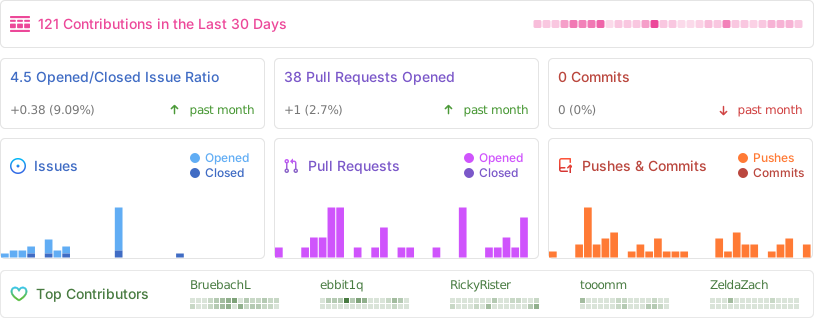
Repository Activity
Code
To commit code to the project, please review our Contribution Guidelines first.
We maintain two tags for contributors to easier find issues to potentially work on:
Issues tagged in this way provide a simple way to get started. They don't require much experience to be worked on.
This tag is used for issues that we are looking for somebody to pick up. Often this is for feature suggestions we support, but don't have the time to work on ourselves.


For both tags, we're willing to provide help to contributors in showing them where and how they can make changes, as well as code reviews for submitted changes.
We'll happily advice on how best to implement a feature, or we can show you where the codebase is doing something similar before you get too far along - put a note on an issue you want to discuss more on!
You can also have a look at our Todo List in our Code Documentation or search the repo for \todo comments.
Documentation 
There are various places where useful information for different needs are maintained:
- Official Code Documentation
- Official Wiki
Community supported - Official Webpage
- Official README
This file - Official CONTRIBUTING
Cockatrice tries to use the Google Developer Documentation Style Guide to ensure consistent documentation.
We encourage everybody to improve the documentation by suggesting edits based on this guide.
Translation 
Cockatrice uses Transifex to manage translations. You can help us bring Cockatrice and Oracle to your language and just adjust single wordings right from within your browser by visiting our Transifex project page. The Webatrice web client manages its own translations in its repo.
Check out our Translator FAQ for more information about getting involved, and join a group of hundreds of others!
Build 

Dependencies: (for minimum versions search our CMake file)
Oracle can optionally use some packages to load compressed card files:
Basic compilation steps:
mkdir build
cd build
cmake ..
make
You can then
- Create a Cockatrice installation inside the
releasefolder:make install - Or make an installation package specific to your system:
make package
Note
Detailed compiling instructions can be found in the Cockatrice wiki at Compiling Cockatrice
The following flags (with their non-default values) can be passed to cmake:
| Flag | Description |
|---|---|
-DWITH_SERVER=1 |
Build Servatrice server |
-DWITH_CLIENT=0 |
Don't build Cockatrice client |
-DWITH_ORACLE=0 |
Don't build Oracle card database tool |
-DCMAKE_BUILD_TYPE=Debug |
Compile in debug mode Enables extra logging output, debug symbols, and much more verbose compiler warnings |
-DWARNING_AS_ERROR=0 |
Don't treat compilation warnings as errors in debug mode |
-DUPDATE_TRANSLATIONS=1 |
Configure make to update the translation .ts files for new strings in the source codeNote: make clean will remove the .ts files |
-DTEST=1 |
Enable regression tests Note: make test to run tests, googletest will be downloaded if not available |
Tip
Build code documentation (Doxygen) according to our configuration into
/docs:doxygen Doxyfile
Run
Cockatrice is the game client
Oracle fetches card data
Servatrice is the server
Docker
You can build an image & deploy a Servatrice (Cockatrice server) container using Docker and our Dockerfile yourself.
For more details, look into our wiki section on Setting up Servatrice.
You'll also find more hints on our pre-build image there, or the docker-compose file which will configure and run both a MySQL server and Servatrice.
License 
Cockatrice is free software, licensed under the GPLv2.