 bdda3dedfa
* [Tests] Register each test case with CTest instead of each test binary

Registering a test cost four edits across a dozen CMakeLists files: add_test,
add_executable, a conditional add_dependencies on gtest, and target_link_libraries.
The conditional branch was the trap -- it is only needed when GTest was fetched and
add_subdirectory'd, and omitting it yields undefined gtest symbols at link time --
so it was easy to leave out and impossible to notice until the link failed.

Fold all four steps into cockatrice_add_test() and migrate every test directory
onto it, with a cockatrice_add_manual_test() wrapper for the three benchmarks that
are built but deliberately kept out of ctest. The calls now read as a declaration
of what a test is rather than a transcript of how to register one.

While rewriting the registrations, replace add_test(NAME x COMMAND x) with
gtest_discover_tests(). Naming the binary as a single CTest entry meant a CI failure
reported only which binary failed, and ctest -R Suite.Case could not select an
individual case. Discovery raises the suite from 35 opaque entries to 469 real ones:
ctest -R ThemeMigrationTest.IsIdempotent now runs exactly that case, and
ctest -L server / -LE bench work off labels applied at registration.

Give every test a 60s TIMEOUT. CTest's implicit default is 1500s, so one hung
socket wait would stall CI for 25 minutes, and single_instance_manager_test already
does real QLocalSocket waits.

Dropping per-case granularity costs wall-clock time, since the suite becomes
process-spawn bound rather than CPU bound: serial ctest went from 3.8s to 30.8s. Run
it with -j in CI to recover it -- 7.6s at -j4, and 3.5s at -j8, both at or below
the old serial time. The binaries are parallel-safe: the only test claiming a fixed
resource scopes its local socket name to its own pid, so concurrent copies cannot
collide.

Also delete dummy_test, which asserted 1 == 1 and only proved the harness was
wired up -- something the other 468 cases already establish.

No test is added, removed, or changed by this commit; the 469 cases are the same
ones the 35 binaries contained.

* [Tests] Make QtTest available to test targets

QtTest was not among the modules test targets could link, so the Qt model and
signal contracts had no way to be verified from a test: QAbstractItemModelTester
and QSignalSpy both live there.

Add Test to _TEST_NEEDED in cmake/FindQtRuntime.cmake. That is the single place the
union of test-only Qt modules is declared, so this is the only file that needs to
change to make the module reachable from every test target.

Nothing uses it yet. This lands the capability ahead of the model-layer tests that
need it, so those can be added as tests alone rather than as test plus build-system
plumbing.

* [Tests] Correct the note on the oracle test compression defines

add_definitions() populates the directory's COMPILE_DEFINITIONS property, which is
consumed at generate time, so it reaches every target in the directory no matter
where it is called relative to add_executable(). The previous note claimed the
flags stayed confined to the benchmark because the find_package block came after
it; oracle_importer_test, created above that block, carries both defines too.

Verified harmless rather than a live bug: HAS_ZLIB and HAS_LZMA gate code only in
oracle/src/pages.cpp and oracle/src/pagetemplates.cpp, and no test target compiles
either. The ordering and the leaked defines are both pre-existing, so this only
corrects the explanation.

* [Tests] Carry one CTest label per test instead of several

gtest_discover_tests() can hand CTest exactly one label. GoogleTestAddTests.cmake
accumulates its generated script with `foreach(arg ${ARGN})`, so a label list reaches
the CTestTestfile as bare `LABELS ci server`, and CTest reads only the first value of a
property and drops the rest without a word.

The `ci` label that is appended to every registered test was therefore absent from every
test that also asked for `server` or `bench`: `ctest -L ci` reported 400 of 469 cases,
and `ctest --print-labels` never listed a second label anywhere in the build.

Reduce each test to exactly one of `ci`, `server`, or `bench`, which is all the
selections need. The three now partition the suite exactly, 400 + 64 + 5 = 469, and
`ctest -LE bench` still means everything but benchmarks. A second label is now a
configure-time FATAL_ERROR rather than a line that quietly means something else.

Anything orthogonal to a test's kind belongs in a helper flag beside the label, so it
composes with the group instead of competing for the single slot.

Also raise DISCOVERY_TIMEOUT off GoogleTestAddTests' 5s default. A plain debug binary
answers --gtest_list_tests in 0.04s, but that budget is thin once several binaries
discover concurrently behind a -j build, and being over it fails at the *link* step with
a bare "Process terminated due to timeout" that points nowhere near the cause.

* [Tests] Link gtest_main on the fetched-gtest path

The downloaded-gtest branch set GTEST_BOTH_LIBRARIES to `gtest` alone, while
FindGTest sets it to both halves. Every test target links that list rather than
picking an entry point, so on this path nothing provides main() and any test
source that does not define its own fails at link with `undefined reference to
main` pointing at crt1.o, naming neither gtest nor the line responsible.

That stayed latent while every test carried its own four-line main(). A test that
omits it now fails, and the error points at the C runtime rather than at gtest,
which is a long way from the cause. Restoring both halves makes the two paths
agree and drops the boilerplate requirement on new test sources.

The 18 sources that still define main() keep linking: gtest_main.cc defines
nothing but main, so the linker leaves its object in the archive unused rather
than reporting a duplicate.

* [Build] Add an ENABLE_SANITIZERS option for ASan and UBSan

Adds -DENABLE_SANITIZERS, off by default, building with AddressSanitizer and
UndefinedBehaviorSanitizer. The bulk of the work is in the three ways the obvious
implementation silently does the wrong thing.

Probe the flags on the link step, not just the compile step. check_cxx_compiler_flag()
only compiles, so every sanitizer flag comes back unsupported, because linking an ASan
object without -fsanitize=address leaves __asan_init undefined. The result is not a
build failure but a build that appears instrumented and is not, which is worse. Use
check_cxx_source_compiles() with CMAKE_REQUIRED_LINK_OPTIONS instead, and treat an
unsupported sanitizer pair as fatal since the cosmetic flags are allowed to degrade.

Opt vendored sources out per source, through a cockatrice_disable_sanitizers_for()
helper rather than a list of set_source_files_properties() calls at the root. The
helper has to exist because CMake resolves a source-file property against the directory
scope its target was declared in: setting the property from the root with absolute paths
is a no-op, silently, which is why the call sites sit next to the add_library and
add_executable that pull the vendored code in. SFMT, minizip, the LZMA SDK and Qxt SMTP
are excluded. oracle/src/qt-json is in the history but not in the tree, removed in
#7214.

Also mark those sources SKIP_PRECOMPILE_HEADERS. The PCH is built with the sanitizer
flags, so it defines __SANITIZE_ADDRESS__; a translation unit compiled with
-fno-sanitize=all does not and GCC then refuses the PCH, which is a fatal
-Werror=invalid-pch in the servatrice and oracle builds.

-fno-sanitize=vptr is not optional. Qt constructs QObject subclasses into raw storage
and writes the vptr afterwards, so the vptr check reports on essentially every QObject
instantiation, and it has no value here because nothing outside moc-generated code
inherits QObject.

Verified on the resulting build: our own translation units carry ASan and UBSan calls,
SFMT.o carries neither, and the full suite of 464 cases passes clean under
ASAN_OPTIONS=detect_leaks=0:abort_on_error=1 with UBSAN_OPTIONS=halt_on_error=0.

The test suite needs two adjustments to make this option usable at all, both of which
land here because they are consequences of COCKATRICE_SANITIZERS existing rather than
independent changes.

DISCOVERY_TIMEOUT rises from 60s to 300s under sanitizers. An instrumented binary takes
2.8s to answer --gtest_list_tests against 0.04s uninstrumented, and discovery runs
several binaries at once behind a -j build.

One target is excluded via a NO_SANITIZE flag, server_developer_role_test. Reaching
google::protobuf::TextFormat::Printer's destructor aborts on an absl assertion inside
system protobuf 33.4 whenever the consumer translation unit is built without NDEBUG,
which a Debug sanitizer build is. This reproduces with no Cockatrice code at all, just
"TextFormat::Printer p; p.PrintToString(msg, &out);" built with -fsanitize=address, so it
is upstream rather than ours. It is a flag and not a fourth label because "skip this in
the sanitizer leg" has to compose with a test's group rather than compete for the single
label slot, and because a flag excludes by not registering the cases at all, which
cannot rot the way a label silently can. The target still builds and still runs on the
legs without sanitizers.

* [CI] Run the suite once under ASan and UBSan

Adds --sanitize to .ci/compile.sh, mirroring --test, and turns it on for one entry of
the existing Linux Docker matrix: Ubuntu 26.04, which already had a test-enabled leg.
That reuses the image, the ccache layer and the existing step shape, so the CI diff is a
matrix key plus the argument plumbing. Debian 13 and Fedora 44 keep covering the
uninstrumented suite, so nothing is lost by instrumenting one leg.

Sanitizers stay off the release and package legs, which build with --release for
packaging: instrumenting those would change the shipped binaries' optimization profile
and build time for no benefit. macOS and Windows stay uninstrumented too, since ASan is
unreliable against the Qt build there and MSVC has no equivalent without /fsanitize=address.

--sanitize does not imply --test, so an instrumented build can be produced locally
without paying for ctest. When both are given, ctest runs with detect_leaks=0 because Qt
and the sanitizer runtimes both leak at exit by design and LeakSanitizer's default buries
real findings under hundreds of process-teardown reports, and with UBSan halt_on_error=0 so
one run collects many findings instead of stopping at the first. ASan keeps
abort_on_error=1, since a bad access leaves the process unusable and continuing only
produces a second, more confusing report from the wreckage.

* [CI] Publish a gcovr line-coverage report from the test run

Sanitizers tell us what a run did wrong; they say nothing about what it never
reached. This adds the other half: an instrumented build whose report says which
of our own lines no test executes.

Add an ENABLE_COVERAGE option that compiles with --coverage -O0 -g, mirroring the
ENABLE_SANITIZERS opt-in including the per-source carve-out that keeps vendored
trees out of the denominator. -O0 is deliberate: at higher optimisation levels GCC
merges and relocates lines, so the report would describe code that no longer exists
in that form. Only GCC is supported, since Clang's intermediate format needs
llvm-cov; asking for coverage under Clang is a hard error rather than a build that
silently produces unreadable .gcno files.

Keep the filters in a committed gcovr.cfg rather than in the invocation. The tests
themselves are excluded because they are compiled with the same instrumentation
and are only ever executed by the run doing the measuring, so leaving them in would
report a healthier project than we have. The process entry points and the client's
window chrome go too: each needs a display, an interactive terminal or a live
database before it does anything a headless test could observe, so they would
otherwise sit at 0% forever and bury real movement.

Give coverage its own matrix leg rather than a second flag on the sanitizer leg.
The two answer different questions, and combining them slows both down without
telling us more. The new variant key gives the leg its own Docker image and ccache
entry so the two legs cannot race on the same tag.

The leg publishes an HTML report with per-file pages, LCOV, Cobertura XML and a
JSON summary. gcovr is a report-time dependency rather than a build dependency, so
a missing one warns and skips instead of failing an otherwise green build.

* [CI] Resolve the coverage source root before the build dir cd

The previous commit computed SRC_ROOT after `cd "$BUILD_DIR"`, under a comment
claiming it ran before. `$0` is relative to the directory the script was invoked
from, so from inside the build dir `dirname "$0"` no longer resolves and the
subshell's `cd` fails. Under `set -e` that is fatal rather than an empty variable,
which took down every leg in the matrix, coverage or not, including the ones this
change does not otherwise touch.

Move it above the cd and guard it on MAKE_COVERAGE, since the coverage report is
the only consumer. Resolving it unconditionally meant a coverage-only detail was
paid for by every build in the fleet, and gave every one of them a way to fail.

---------

Co-authored-by: Lukas Brübach <Bruebach.Lukas@bdosecurity.de>

Cockatrice | Download | Related | Community | Contribute | Build | Run
To get started with Cockatrice ⇢ view our webpage

To get support, or suggest changes to the app ⇢ file an issue (How?)
To help with development ⇢ learn how to contribute
Cockatrice
Cockatrice is an open-source, multiplatform application for playing tabletop card games over a network. The program's server design prevents users from manipulating the game for unfair advantage. The client also provides a single-player mode, which allows users to brew while offline.
This project uses C++ and the Qt libraries.
Download 
Downloads are available for stable releases and the current beta version in development.
There is no strict release schedule for either of them.
Latest stable release:


Latest beta version:


While incorporating the latest fixes and features, beta builds may not be stable or contain new bugs! Please report any findings and open new issues when testing them!
Related Repositories
- Magic-Token: File with MtG token data for use in Cockatrice
- Magic-Spoiler: Code to generate MtG spoiler data from MTGJSON for use in Cockatrice
- cockatrice.github.io: Code of the official Cockatrice webpage
- io.github.Cockatrice.cockatrice: Configuration of our Linux
flatpakpackage hosted at Flathub - Webatrice: Web client for Cockatrice servers (TypeScript / React)
Community Resources 
Join our Discord community to connect with other project contributors (#dev channel) or fellow users of the app. Come here to talk about the application, features, or just to hang out.
Important
For support regarding specific servers, please contact that server's admin/mods and use their dedicated communication channels rather than contacting the team building the software.
Contribute
Code | Documentation | Translation
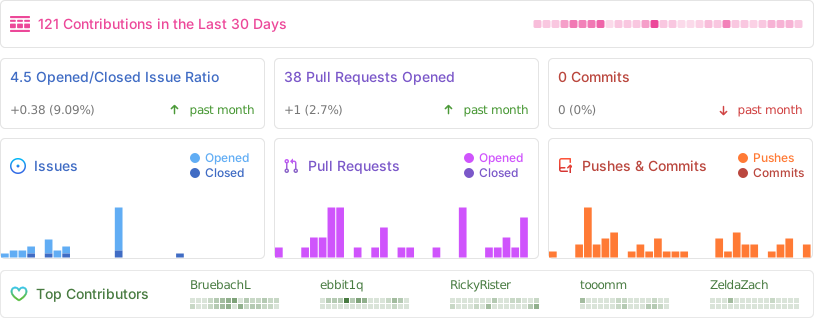
Repository Activity
Code
To contribute code to the project, please review our guidelines first.
We maintain two tags for contributors to easier find issues to potentially work on:
Issues tagged in this way provide a simple way to get started. They don't require much experience to be worked on.
This tag is used for issues that we are looking for somebody to pick up. Often this is for feature suggestions we support, but don't have the time to work on ourselves.


For both tags, we're willing to provide help to contributors in showing them where and how they can make changes, as well as code reviews for submitted changes.
We'll happily advice on how best to implement a feature, or we can show you where the codebase is doing something similar before you get too far along - put a note on an issue you want to discuss more on!
You can also have a look at our Todo List in our Code Documentation or search the repo for \todo comments.
Documentation 
There are various places where useful information for different needs are maintained:
- Official Code Documentation
- Official Wiki
Community supported - Official Webpage
- Official README
This file - Official CONTRIBUTING
Cockatrice tries to use the Google Developer Documentation Style Guide to ensure consistent documentation. We encourage you to improve the documentation by suggesting edits based on this guide.
Translation 
Cockatrice uses Transifex to manage translations. You can help us bring Cockatrice and Oracle to your language and just adjust single wordings right from within your browser by visiting our Transifex project page. The Webatrice web client manages its own translations in its repo.
Check out our Translator FAQ for more information about getting involved, and join a group of hundreds of others!
Build 

Dependencies: (for minimum versions search our CMake file)
Oracle can optionally use some packages to load compressed card files:
Basic compilation steps:
mkdir build
cd build
cmake ..
make
You can then
- Create a Cockatrice installation inside the
releasefolder:make install - Or make an installation package specific to your system:
make package
Note
Detailed compiling instructions can be found in the Cockatrice wiki at Compiling Cockatrice
The following flags (with their non-default values) can be passed to cmake:
| Flag | Description |
|---|---|
-DWITH_SERVER=1 |
Build Servatrice server |
-DWITH_CLIENT=0 |
Don't build Cockatrice client |
-DWITH_ORACLE=0 |
Don't build Oracle card database tool |
-DCMAKE_BUILD_TYPE=Debug |
Compile in debug mode Enables extra logging output, debug symbols, and much more verbose compiler warnings |
-DWARNING_AS_ERROR=0 |
Don't treat compilation warnings as errors in debug mode |
-DUPDATE_TRANSLATIONS=1 |
Configure make to update the translation .ts files for new strings in the source codeNote: make clean will remove the .ts files |
-DTEST=1 |
Enable regression tests Note: make test to run tests, googletest will be downloaded if not available |
Tip
Build code documentation (Doxygen) according to our configuration into
/docs:doxygen Doxyfile
Run
Cockatrice is the game client
Oracle fetches card data
Servatrice is the server
Docker
You can build an image & deploy a Servatrice (Cockatrice server) container using Docker and our Dockerfile yourself.
For more details, look into our wiki section on Setting up Servatrice.
You'll also find more hints on our pre-build image there, or the docker-compose file which will configure and run both a MySQL server and Servatrice.
License 
Cockatrice is free software, licensed under the GPLv2.